Application Report

Vibration Measurement of a Printed Circuit Board (PCB)

How does mechanical stress distribute across a  printed circuit board – and which components are affected? Laser Doppler vibrometry provides the spatial answer. This report presents three measurement approaches for printed circuit boards (PCBs):

From full-area out-of-plane measurement to 3D vibration analysis and 3D single-point measurement.

Full-area measurement normal to the surface (out-of-plane)

A scanning vibrometer covers the entire board and reveals vibration hotspots at component level.

Full-area three-dimensional measurement (X/Y/Z, in-plane + out-of-plane)

Three synchronized vibrometers capture in-plane motion, tilting motion and thermal expansion.

Three-dimensional measurement at a fixed point (single-point, X/Y/Z, in-plane + out-of-plane)

Compact fiber-optic sensor head for 3D measurement at a defined point – ideal for shaker tests.

Problem Statement

Printed circuit boards in automotive, aerospace and industrial applications are exposed to vibrations and shocks during operation. The resulting stress is not evenly distributed but concentrates in local hotspots – at points of maximum deflection, near heavy components, and at transitions between the board and connectors.

  • Conventional sensors
    Individual accelerometers capture the vibration response at only a few discrete points, add mass to the test specimen and provide no spatial picture of the stress distribution.

The key questions

  • Where do failures occur?
    Which areas on the board are exposed to the highest loads – and which components are affected?
  • What needs to be changed?
    The results reveal where mounting, solder joints or component placement need to be modified.
  • Will the assembly withstand long-term stress?
    A circuit board in an engine compartment, for example, must operate reliably over the entire vehicle lifetime – approximately 300,000 km or more under permanent load. Weak points must be identified and resolved before the assembly enters series production.

Full-Area Out-of-Plane Measurement with a Scanning Vibrometer

Test Specimen
Printed circuit board (PCB)
Measurement System
Optomet laser scanning vibrometer
Software
SMART Lab
Analysis
Full-field ODS, operating deflection shapes at component level

Objective

The objective of this measurement is to visualize the full-area out-of-plane vibration behavior of a automotive printed circuit board under controlled excitation. Instead of a single measurement point, the entire board surface is scanned – to identify where vibration amplitudes normal to the surface are highest: at board level and at component level. The resulting operating deflection shapes (ODS) reveal which areas and components are exposed to the highest dynamic loads.

1
Measurement Setup

The printed circuit board is mounted on an electrodynamic shaker. The scanning vibrometer is installed on a portable aluminum profile frame above the test specimen, looking straight down onto the board surface. This configuration provides the optimal measurement angle for out-of-plane vibration measurements.

Measurement setup: Optomet scanning vibrometer on a portable gantry frame, positioned vertically above the printed circuit board on an electrodynamic shaker. The compact all-in-one design requires no external DAQ hardware.

The Optomet scanning vibrometer combines vibrometer, data acquisition, signal generator and camera in a single device. No additional external hardware is required for this measurement. The excitation signal for the shaker is generated directly by the integrated signal generator.

2
Define Measurement Points in SMART Lab

The SMART Lab software displays a live image of the test specimen via the integrated camera. The measurement area and scan grid are defined directly on this camera image. Area selection, mesh generators and component-by-component assignment allow precise placement of measurement points – from a coarse full-board grid to dense grids on individual components.

PCB in the SMART Lab geometry view. Measurement areas and mesh points are placed interactively on the live camera image.
Defined scan grid on the printed circuit board. The mesh density can be adjusted locally – denser grids where higher spatial resolution is needed.

Both images show the component side of the printed circuit board from slightly different perspectives. The left image shows the measurement areas and boundary tools being defined, while the right image displays the finished measurement point grid. SMART Lab supports multiple layers, allowing different measurement areas – such as a coarse full-board grid and dense grids on individual components – to be managed within a single project.

3
Configure Measurement Parameters

The vibrometer settings are configured in the acquisition module. For this PCB measurement, the upper frequency limit is set to 100 kHz – sufficient to capture both the fundamental resonances of the board (typically below 5 kHz) and higher-order component modes. With over 13 million FFT lines and a frequency resolution of 6.4 mHz, even closely spaced modes are clearly separated.

Measurement settings in SMART Lab: 100 kHz maximum frequency, 216 kS/s sampling rate, 10 averages per point. Autofocus and vibration measurement are enabled for the scan.
Portrait of Tobias Schröder, Head of Sales & Marketing at Optomet

"For printed circuit boards with lightweight components, non-contact measurement is a prerequisite for reliable data. Every gram of added mass changes the result."

Tobias Schröder (M.Sc. Mechanical Engineering)
Head of Sales & Marketing

4
Automatic scanning

Once the grid and settings are defined, the vibrometer automatically scans all predefined measurement points. The laser moves from point to point, adjusts the focus as needed, records the vibration signal and advances to the next position. No manual intervention is required during the scan.

Automatic scan in action: the laser works through the predefined measurement point grid autonomously. The green laser spot is visible on the board surface.

The measurement is entirely non-contact. No sensors on the board, no cables, no additional mass on the structure. The results represent the actual vibration behavior of the assembly.

5
Visualization and Analysis

After the scan is complete, SMART Lab offers various display modes in the analysis tab. The vibration data can be shown as color-coded points overlaid on the camera image, as an interpolated color map or as a wireframe model with animated deformation. Damping information can be included in the visualization.

Point-based visualization: color-coded vibration amplitudes overlaid on the camera image. Different board areas and individual components are clearly distinguishable.
Interpolated color map: a clearly visible mode shape with several maxima (yellow/red) and nodal areas (blue).

The color map visualization makes the global board modes immediately visible: in this case, a higher-order mode shape with several pronounced amplitude maxima distributed across the board is revealed. Where these maxima occur relative to component positions is directly relevant for reliability assessment – components near a vibration maximum are exposed to the highest dynamic loads.

What the measurement reveals: The interpolated ODS visualization shows that the board corners and areas near the large connectors exhibit the highest vibration amplitudes at certain frequencies. Capacitors and IC packages in these zones are exposed to increased mechanical stress – making them candidates for repositioning or reinforced attachment in a design revision.

6
Component Detail Analysis and Video Export

In addition to the full-board view, SMART Lab allows zooming into individual components to display their local deflection shapes. The integrated video recording function generates 4K videos of the animated vibration data – including tracking shots that move the virtual camera across the board surface. Ideal for presentations and reports.

Component detail view with video export: each capacitor shows its individual vibration pattern. The tracking shot function produces smooth camera movements across the board for 4K video recordings.

The detail view shows how each individual component responds to the excitation. In this close-up, the electrolytic capacitors each exhibit a distinct vibration pattern – some tilt laterally, others show vertical displacement. This level of detail is only possible with the spatial resolution of a scanning vibrometer and remains invisible in conventional accelerometer measurements.

From 1D to 3D: What Remains Invisible

The measurement so far captures the velocity component normal to the board surface. For many PCB analyses, this is sufficient – bending modes dominate, and the largest deflection occurs out-of-plane. However, the detail view of the capacitors in step 6 already hints at what a pure out-of-plane measurement cannot fully capture: some components tilt laterally, not just vertically.

On printed circuit boards, there are several situations where in-plane motion plays a decisive role:

  • Connectors and tall components – move laterally and generate bending stress at their solder joints in the board plane
  • Board torsion – twisting produces significant motion components in the X and Y directions, not just normal to the surface
  • Complex mounting conditions – bolted housings or press-fit connections introduce forces into the board in all three spatial directions
  • Thermal expansion – different coefficients of thermal expansion between the board, solder joints and components cause local deformations in the board plane

In all these cases, a pure out-of-plane measurement provides an incomplete picture. The following sections show what 3D measurement additionally reveals on the same printed circuit board.

3D Vibration Analysis (SMART 3D-Scan)

Real measurement data, not simulation – The visualization shows a real 3D vibration measurement of the printed circuit board, captured with the SMART 3D-Scan. The measurement data can be projected directly onto the 3D model of the board – making it immediately visible which components and areas are affected.

Test Specimen
Automotive printed circuit board
Measurement System
SMART 3D-Scan (3 × SMART Scan+)
Measured Quantities
Velocity in X, Y and Z per measurement point
Visualization
3D model mapping, camera overlay, animated deflection shapes

Three synchronized SMART Scan+ vibrometers measure simultaneously from different angles.

From the three velocity components, the software calculates the complete motion in X, Y and Z at each measurement point. The measurement workflow in SMART Lab is essentially identical to the 1D case: define measurement points on the 3D model or camera image, scan automatically, visualize the results. The key difference lies not in the workflow – but in what the results reveal.

Why 3D instead of out-of-plane only?

The 3D measurement reveals motion components that remain hidden in a pure out-of-plane analysis. In particular, the lateral movement of connector headers, the tilting behavior of tall electrolytic capacitors and the rocking motion of transistors are only fully captured in the 3D dataset – and with them the actual stress on the corresponding solder joints.

Thermal Expansion: Same System, Different Question

In addition to vibration analysis, the same SMART 3D-Scan vibrometer can also capture the thermal expansion of the printed circuit board and its components. Different coefficients of thermal expansion between the FR4 substrate, copper traces, solder joints and package materials produce local deformations during temperature changes that can lead to fatigue damage.

For temperature cycling tests (TCT) and the assessment of thermo-mechanical reliability, the 3D measurement of thermal expansion provides the spatial evidence that would only be available at a few discrete points with strain gauges – non-contact and across the entire surface.

3D Single-Point Measurement with the SMART 3D-Fiber

Test Specimen
ECU (electronic control unit) on electrodynamic shaker
Measurement System
SMART 3D-Fiber (3D single-point vibrometer)

Not every PCB analysis requires a full-area scan grid. For shaker tests on electronic control units (ECUs), qualification of individual assemblies or monitoring of defined measurement points in series testing, a single measurement point is sufficient – provided it captures all three spatial directions.

The SMART 3D-Fiber delivers exactly that: three laser beams converge on the same surface point and capture the complete 3D vibration motion. The compact fiber-optic sensor head is particularly suited for confined installation situations – such as measuring directly on a printed circuit board inside an enclosure.

The X, Y and Z velocity components are available directly at the digital and analog outputs. The SMART 3D-Fiber can be operated both via SMART Lab and directly through an external DAQ system – no proprietary software is required for integration into existing test rigs.

Application example – ECU shaker test: In vibration analysis of electronic control units, the 3D single-point measurement captures the complete vibration at a defined measurement point – including the in-plane components that remain invisible with conventional 1D accelerometers. For users who need to monitor a defined point over an extended period or under varying conditions, the SMART 3D-Fiber is the compact alternative to full-area 3D scanning.

Which System for Which Measurement Task?

All three measurement approaches presented in this report use Optomet laser Doppler vibrometry and the SMART Lab software. The choice of system depends on what information is required:

Measurement TaskScanning Vibrometer
1D, full-area
SMART 3D-Scan
3D, full-area
SMART 3D-Fiber
3D, single-point
Out-of-plane vibration
In-plane vibration
Full-field ODS / mode shapes
Thermal expansion

Scanning Vibrometers for PCB Vibration Analysis

Classic Series
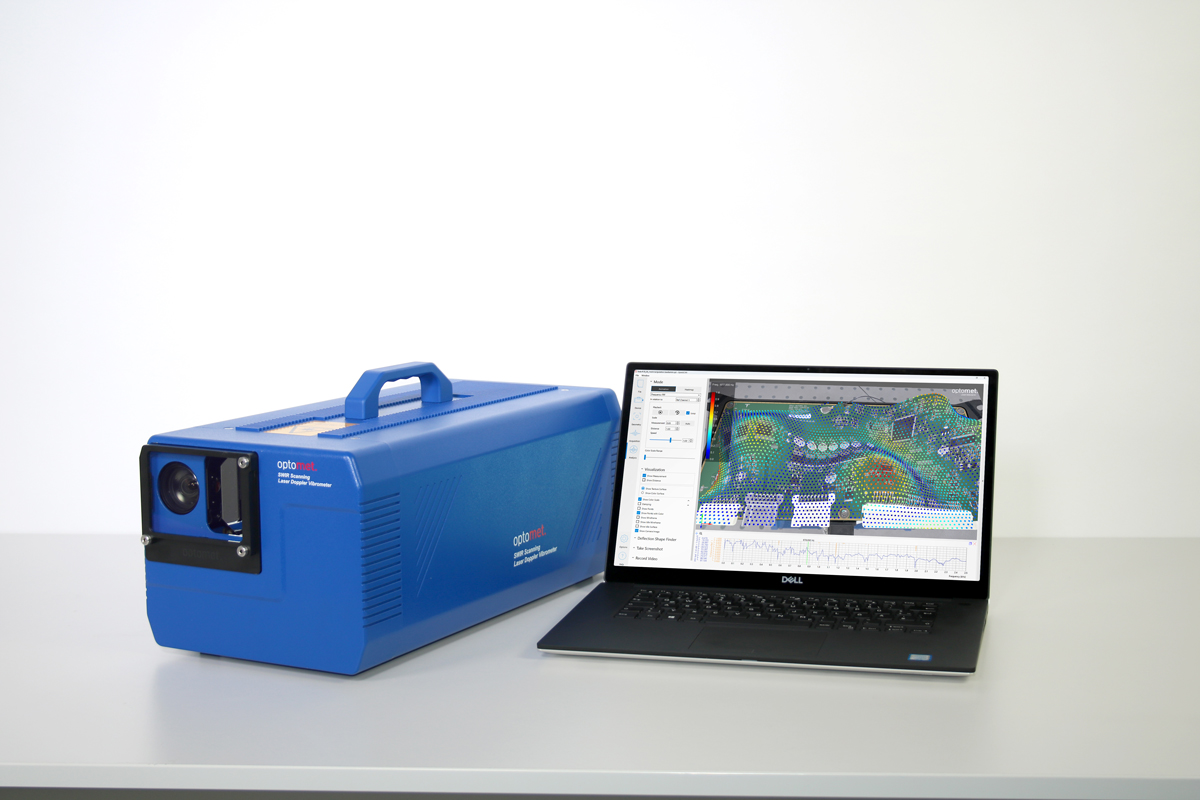
SWIR Scanning Vibrometer

SWIR Scanning Vibrometer

Scanning laser Doppler vibrometer with SWIR technology (1550 nm), eye-safe measurement laser (Class 1) and digital FPGA signal processing.

  • Frequency bandwidth: DC to 10 MHz (24 MHz)
  • Max. velocity: 25 m/s
  • Grid density: up to 512 × 512 points
  • Weight: 12 kg
  • Full HD camera, 30× optical zoom
SWIR Scanning Vibrometer →
Smart Series · Successor
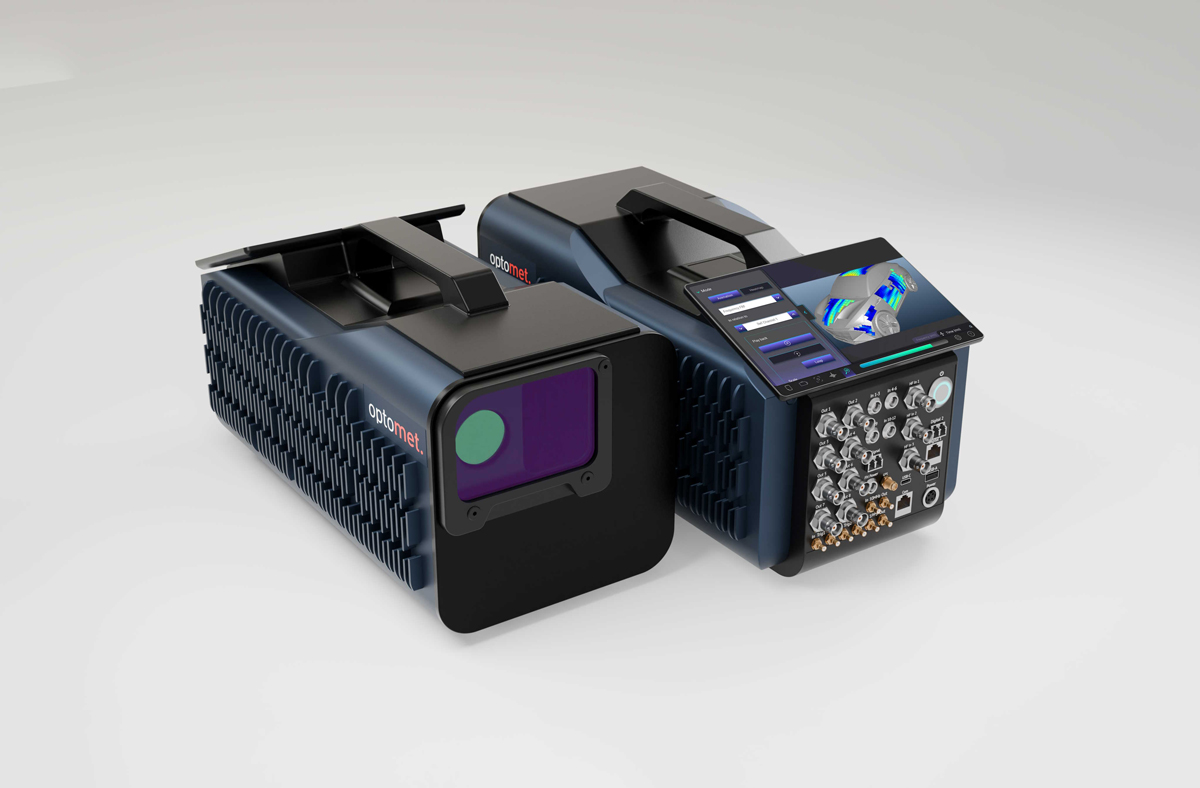
SMART Scan+

SMART Scan+

The current generation: fully integrated scanning vibrometer with extended bandwidth, 4K camera, integrated DAQ and up to 12 reference channels – no external hardware required.

  • Frequency bandwidth: DC to 50 MHz
  • Max. velocity: 50 m/s
  • Grid density: up to 512 × 512 points
  • Weight: 8.2 kg
  • 4K camera, 20× opt. / 40× hybrid zoom
  • Integrated DAQ & signal generator
  • Up to 12 reference channels (IEPE/TEDS)
  • Wi-Fi 7, Bluetooth 5.2, GNSS
  • 7" touchscreen, SMART Lab software
SMART Scan+ →
Smart Series · 3D
SMART 3D-Scan

SMART 3D-Scan

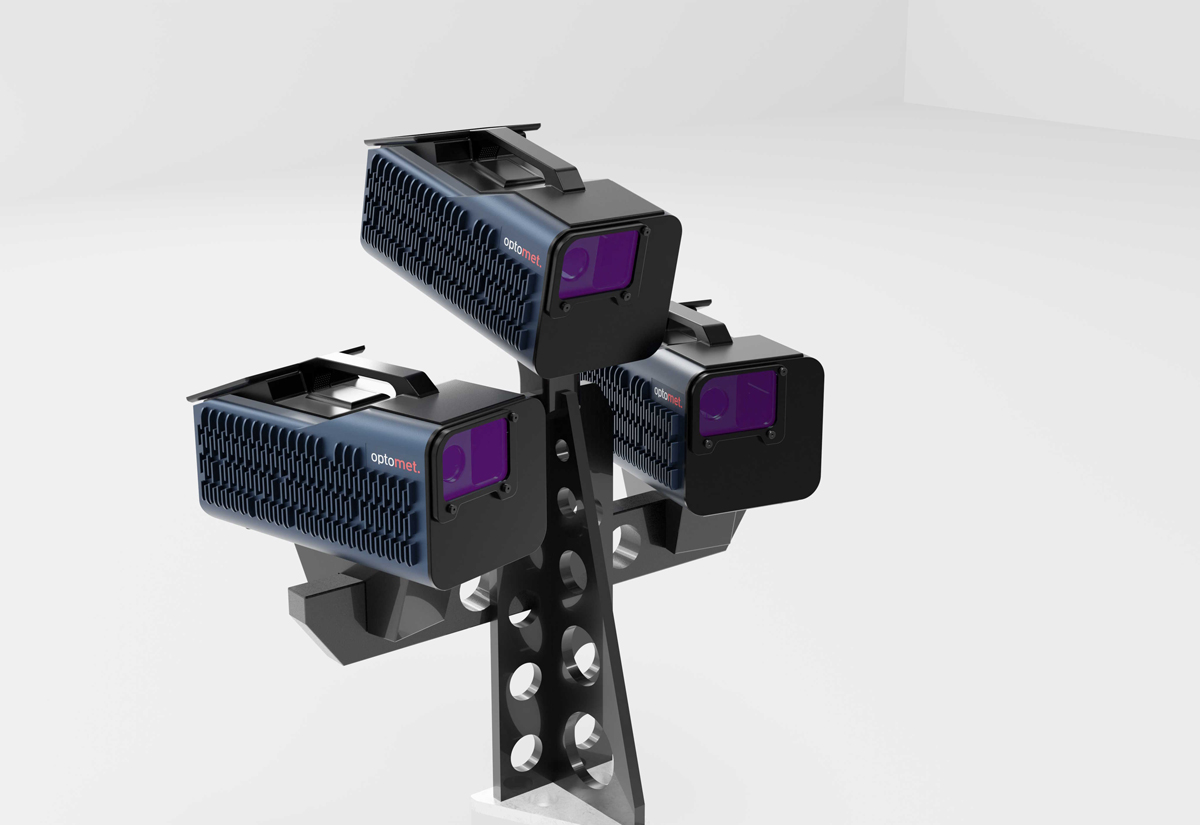
Product photo SMART 3D-Scan (three vibrometers)

Three synchronized SMART Scan+ for complete X/Y/Z measurement at every scan point. Modular upgrade path.

  • 3 × SMART Scan+
  • Synchronized 3D acquisition
  • Each unit also usable individually
  • Up to 36 reference channels
SMART 3D-Scan →
Smart Series · 3D
SMART 3D-Fiber

SMART 3D-Fiber

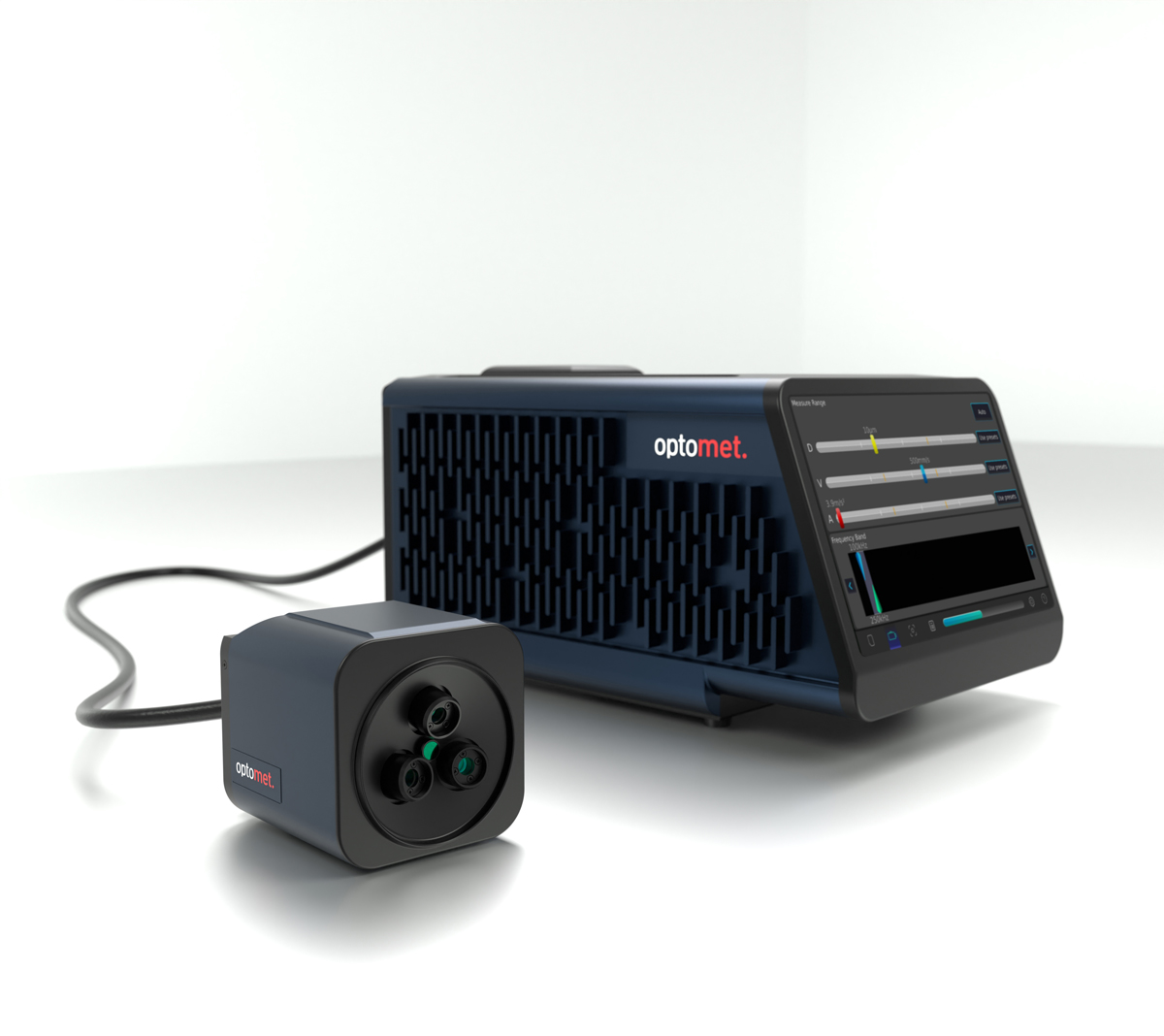
Product photo SMART 3D-Fiber with fiber-optic sensor head

3D single-point vibrometer with compact fiber-optic sensor head. Direct X/Y/Z output at the analog and digital outputs.

  • Compact 3D fiber-optic sensor head (107 × 100 × 102 mm)
  • Working distance 83 mm
  • Integrated webcam for alignment
  • Operation via SMART Lab or external DAQ
SMART 3D-Fiber →

The basic measurement workflow is comparable across all four systems. The choice depends on the measurement task: full-area or single-point, 1D or 3D – or both, as the SMART systems can be combined and expanded step by step.

Summary

This application report presents three measurement approaches for vibration analysis of printed circuit boards using Optomet laser Doppler vibrometers.

Full-area out-of-plane measurement: A single scanning vibrometer captures the vibration component normal to the board surface. Six steps from setup to component detail analysis demonstrate the complete workflow. The results identify spatial vibration hotspots, reveal mode shapes at board level and show the individual vibration behavior of single components.

3D vibration analysis: Three synchronized SMART Scan+ vibrometers capture the complete motion in X, Y and Z. This reveals lateral movement, tilting motion and coupled modes that remain hidden in the out-of-plane measurement. The same system also captures thermal expansion – relevant for assessing thermo-mechanical reliability.

3D single-point measurement: The SMART 3D-Fiber provides complete 3D vibration information at a defined measurement point. The compact fiber-optic sensor head is suited for shaker tests on electronic control units, component qualification and integration into existing test rigs.

All three approaches deliver the spatial evidence for targeted design decisions: component repositioning, local stiffening, adjustment of mounting conditions or FEM validation against measured reality.

Full-area vibration analysis for your printed circuit boards? Optomet provides the right measurement solution.